Understand ve(3,3)
This is the most important page in the guide. Once ve(3,3) clicks, everything else on BarkSwap — locking, voting, gauges, bribes, rebases — stops looking like jargon and starts looking like one simple, self-reinforcing loop.
We'll build it up one idea at a time. No code, no math beyond grade-school.
The problem it solves
Every DEX needs liquidity — tokens sitting in pools so people can trade. The classic way to attract liquidity is to print a reward token and hand it to anyone who deposits. It works for a while, then it doesn't: the people farming the rewards dump the token, the price falls, the rewards become worthless, and the liquidity leaves for the next farm. This is often called "mercenary capital."
ve(3,3) fixes this by changing who decides where the rewards go and giving them a reason to stay.
The two halves of the name
ve(3,3) is two ideas glued together:
- ve = vote-escrow. You escrow (lock up) the BARK token for a while, and in return you get voting power. The longer you lock, the more power you get. Locking signals you're here for the long run — not to dump.
- (3,3) comes from game theory. It's shorthand for: if everyone cooperates (locks and votes), everyone wins the most. The system is designed so the selfish move and the cooperative move are the same move.
Put together: lock the token to earn a say in the rewards, and you're rewarded for staying.
The flywheel
Here's the whole thing in one picture. Read it as a loop that keeps spinning:
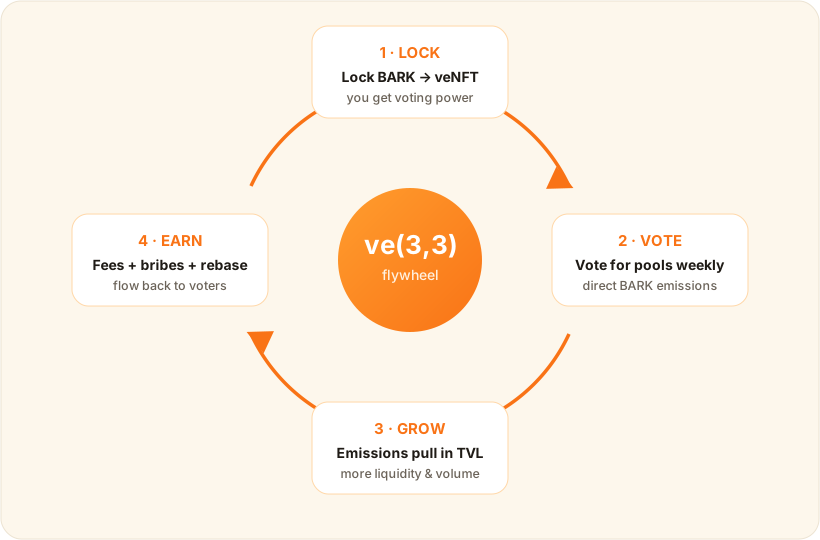
- Lock — you lock BARK and receive a veNFT. That NFT is your voting power.
- Vote — once a week you point your voting power at the pools you choose. BARK emissions (freshly minted reward tokens) are split between pools in proportion to the votes they get. More votes → more emissions for that pool.
- Grow — a pool flush with emissions attracts liquidity providers chasing those rewards. More liquidity means better prices, which attracts more traders, which means more trading volume.
- Earn — that volume produces trading fees, and projects that want their pool to win often add bribes (extra incentives). Both go to the people who voted for that pool — you. On top, you receive a rebase that offsets the new BARK being minted, so your share of the supply isn't diluted away.
And then you take what you earned, lock more, and the wheel spins faster. That's ve(3,3).
Who's who in the loop
ve(3,3) lines up three groups so that each one's selfish goal helps the others:
| You are a… | You do this | You earn this |
|---|---|---|
| Trader | Swap tokens | Best prices (deep liquidity) |
| Liquidity provider (LP) | Deposit tokens into a pool, stake it | Trading fees + BARK emissions |
| Voter (BARK locker) | Lock BARK, vote weekly | Trading fees + bribes + rebase |
Notice the split that makes BarkSwap tick:
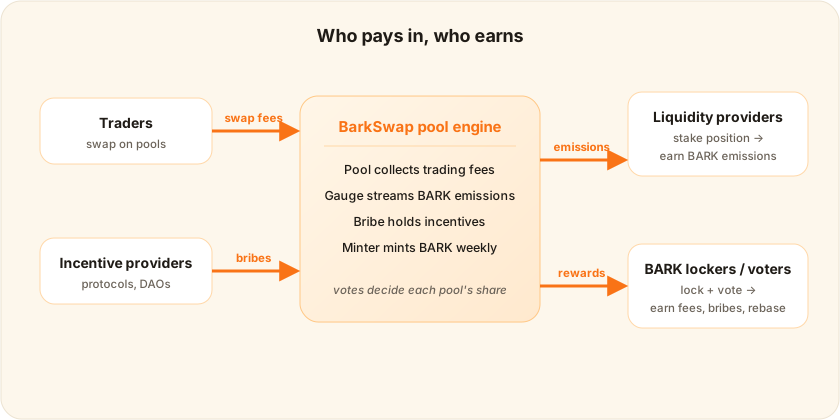
- Liquidity providers earn the BARK emissions (by staking their position — more on that in the liquidity guide).
- Voters earn the trading fees and bribes from the pools they backed, plus the rebase.
So LPs and voters need each other: LPs want emissions, voters control where emissions go, and projects pay bribes to win the voters over. Everyone is pulling the same wheel.
Why locking is the clever part
A normal staked token can be sold the instant rewards arrive. A locked token can't. By making voting power come only from locked BARK, ve(3,3) guarantees that the people steering the rewards are the people committed to the protocol's future. They're incentivized to vote for pools that bring real volume and fees — because that's what pays them.
The longer you lock, the more power (and the bigger your share of fees, bribes, and rebase). That's the "stay and you win" part of (3,3).
Think of your veNFT as a steering wheel for BarkSwap's rewards. Each week you turn it toward the pools you believe in. The pools you steer toward grow — and they pay you tolls (fees and bribes) for sending traffic their way.
The weekly rhythm
The whole loop runs on a clock. BarkSwap time is measured in epochs — one week each, flipping every Thursday at 00:00 UTC. You vote during the week; at the flip, emissions go out and rewards become claimable. The next page covers this in detail.
Recap
- ve = lock BARK to get voting power (a veNFT). Lock longer for more power.
- (3,3) = the system rewards cooperation; staying long-term is the winning move.
- Emissions (new BARK) go to pools by vote, and reward the LPs in those pools.
- Fees + bribes + rebase reward the voters who directed the emissions.
- It all repeats every week, and every turn of the wheel makes the next turn stronger.
Ready to do it? Start with The BARK token, then lock BARK and vote.